Hello San Diego diners!
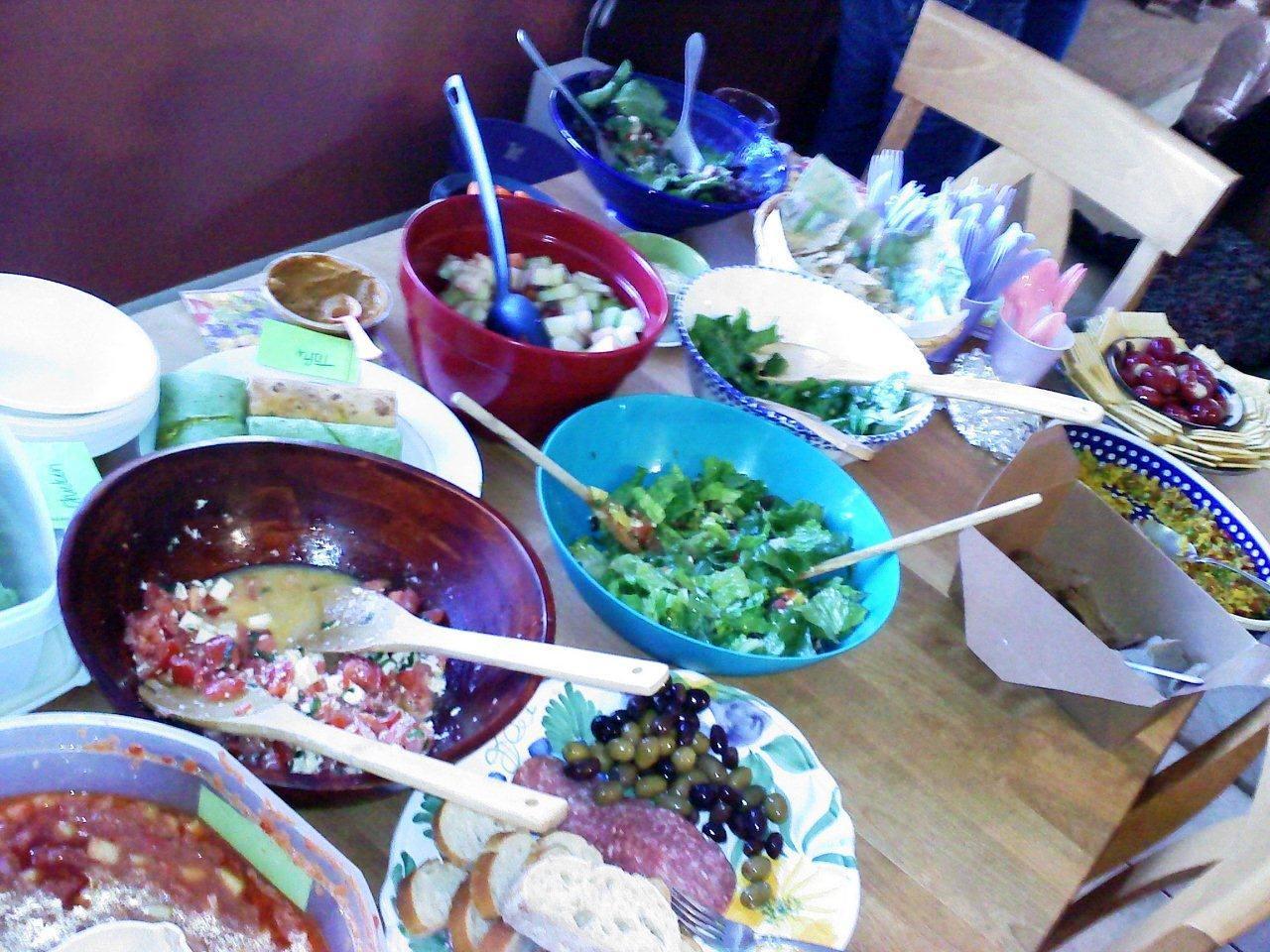
We kicked off a new year of DFW at Lauren's house in South Park with a variety of yummy Indian-inspired dishes. Unfortunately, we ended up with several no-shows and had way too much food leftover. We were all well-fed with what was left for the rest of the week, though!
We also had some technical difficulties watching the presentation on January's featured charity, Matrichaya. If you haven't already, please watch these videos describing Matrichaya and their impact in India.
Stay tuned for details on February's dinner, soon.
Saturday, February 5, 2011

Monday, December 27, 2010
Rubia Handwork: November 12, 2010
Greetings Diners!
A special (though belated) thank you to Karen C. for hosting our November 2010 dinner. We had 11 attendees and collectively raised $178 to support Rubia’s Threads of Change Program in Nangtahar, Afghanistan.
A special (though belated) thank you to Karen C. for hosting our November 2010 dinner. We had 11 attendees and collectively raised $178 to support Rubia’s Threads of Change Program in Nangtahar, Afghanistan.
 To learn more about Rubia and their efforts to provide economic opportunities to marginalized Afghan women, take a look at the following video:
Our chapter has decided to take a short hiatus due to general holiday chaos, but will reconvene in January to support Matrichaya in India. We are looking for hostesses for the first quarter of 2011, so please drop me a note at erikakeaveney@gmail.com if you can offer up your home or office.
I would also like to encourage you to consider donating to Dining for Women’s 2010 Annual Appeal to help cover their operating expenses: http://diningforwomen.org/node/686. Doing so will continue to ensure that 100% of every donation made at the monthly meetings goes directly to projects on the ground.
Also – if you would like to learn about December’s feature charity (The BOMA Fund in Kenya), please visit http://diningforwomen.org/node/183. You can easily make a contribution to this project by clicking the “donate” button in the upper right hand of the page.
We thank your continued participation and we look forward to growing our chapter in 2011!
Wishing you health, peace and prosperity in the New Year!
Warmly,
Erika Keaveney
Wednesday, November 3, 2010
November's Charity: Rubia's Threads of Change program in Afghanistan
Hello San Diego diners! We regret that we were unable to meet last month due to several conflicts, but we hope that this month's DFW event will make up for it. Please join us on Friday, November 12th at 6:30pm to learn more about this month's featured charity, socialize and dine with some amazing local women!
We all have heard a lot about Afghanistan in the United States through the media, but a lot of us probably do not understand how women's lives are there today. Here are some very compelling facts:
As the Taliban continue to resist the new government and U.S. occupation, ethnic
tension, attacks by the Taliban,
and government corruption have spread violence and poverty throughout the region. Although the Taliban's hold of Afghanistan has reduced overall and many rights were granted to women with 2004 constitution, regions like southern Afghanistan are still under the grip of Taliban influence. Women receive night letters that warn them against returning to work or speaking out. For example:
"We warn you to leave your job as a teacher as soon as possible , otherwise we will cut the heads off your children and shall set fire to your daughter."
And:
“We will kill you in such a harsh way that no woman has so far been killed in that manner."
‐‐‐Time magazine’s reports of letters obtained by Human Rights Watch
According
to
the
2009
Human
Development
Report,
Afghanistan
is
listed
as
the
world’s
second
least
developed
country.
For
Afghan
girls
in
some
regions,
education remains
elusive or forbidden. Poverty
is
a
major
barrier
to
education,
especially
among
older
Afghan
girls. Afghan
Women
are
slowly
rising
to
political power,
but
usually
only
when
quotas
and
other
special
measures
are
enforced.
Maternal health is also a very serious issue in Afghanistan, where skilled care is lacking. Poverty
and
a
lack
of
education
also
lead
to
high
adolescent
birth
risks,
and
use
of
contraception
is
lowest
among
the
poorest
women
and
those
with
no
education.
The
Badakhshan
Province
in
northeastern
Afghanistan
has
the
highest
maternal
morbidity
rate
in
the
world.
Many people in Afghanistan turn to illicitly growing opium poppies as a reliable source of income. Afghanistan currently supplies at least 93% of the world's opiates.
Security is the most significant issue in Afghanistan. It is difficult for the Afghan and U.S. governments to focus on human rights when the Afghan government is at war. Nonprofit organizations are helping women get back on their feet after three decades of warfare. Many NGOs (nongovernmental organizations) are working in Afghanistan to empower women by, for example, training women to be health and birth attendants and selling crafts made by Afghan women. Proceeds go back to the women. In a world of patriarchal rule and domestic violence, women can learn to support themselves without men through their crafts.
The mission of Rubia in Afghanistan is to develop economic opportunities through craft heritage, to support education, and to promote health and well-being for Afghan women and their families.
From Rubia: “What differentiates us from other non-governmental organizations (NGOs) is the access and context in which we work. Most NGOs working in Afghanistan avoid programs in the countryside due to lack of security. Rubia, through its grassroots network and strong relationship with other local organizations, works primarily among the rural population, the most marginalized of Afghan women; our programs are driven by their needs and capacity. We are committed to improving conditions for Afghan women and their families in incremental, sustainable steps. Above all, we respect and function within the cultural norms and day-to-day realities of Afghan family life.”

The Threads of Change Program: Dining for Women's donations will fund the development and implementation of Rubia’s Threads of Change Program. The integrated program in literacy, health, human rights, civics and handwork will impact over 600 women in Nangtahar, Afghanistan, mentoring emerging leaders to continue and expand the program. This program teaches practical skills and disseminates information about rights, civics, income and health, thus empowering Afghan women and their families.

Rubia eloquently describes more about the program in a way a lot of women here can understand in their latest newsletter on their website: "Contrary to the image of stitchery as retro domesticity, imprisoning women in their customary and predictable roles, we view embroidery as a positive and actual means of liberation for Afghan women. [...] Needlework may be the most feminine of art forms, but it is a means to liberation as well. The needle is so much more than a sewing tool: for Rubia women who first learn to spell their names in stitchery, it is a writing tool as well. For rural Afghan women, credibility and status can only be raised in a way that is meaningful to their community; within the culture and rhythm of their daily lives. It will take time for their work to be valued, in the long term, starting slowly and building over time. We recognize that change in Afghanistan is generational."

You can read more about Rubia on Dining For Women's site and at their homepage.
If you are not on our evite distribution and would like to be, please email erikakeaveney@gmail.com. These dinners are open to the public, though for reasons of privacy and limited space, we will not be publishing event details on the blog.
We all have heard a lot about Afghanistan in the United States through the media, but a lot of us probably do not understand how women's lives are there today. Here are some very compelling facts:
"We warn you to leave your job as a teacher as soon as possible , otherwise we will cut the heads off your children and shall set fire to your daughter."
And:
“We will kill you in such a harsh way that no woman has so far been killed in that manner."
‐‐‐Time magazine’s reports of letters obtained by Human Rights Watch
Security is the most significant issue in Afghanistan. It is difficult for the Afghan and U.S. governments to focus on human rights when the Afghan government is at war. Nonprofit organizations are helping women get back on their feet after three decades of warfare. Many NGOs (nongovernmental organizations) are working in Afghanistan to empower women by, for example, training women to be health and birth attendants and selling crafts made by Afghan women. Proceeds go back to the women. In a world of patriarchal rule and domestic violence, women can learn to support themselves without men through their crafts.
The mission of Rubia in Afghanistan is to develop economic opportunities through craft heritage, to support education, and to promote health and well-being for Afghan women and their families.
From Rubia: “What differentiates us from other non-governmental organizations (NGOs) is the access and context in which we work. Most NGOs working in Afghanistan avoid programs in the countryside due to lack of security. Rubia, through its grassroots network and strong relationship with other local organizations, works primarily among the rural population, the most marginalized of Afghan women; our programs are driven by their needs and capacity. We are committed to improving conditions for Afghan women and their families in incremental, sustainable steps. Above all, we respect and function within the cultural norms and day-to-day realities of Afghan family life.”
The Threads of Change Program: Dining for Women's donations will fund the development and implementation of Rubia’s Threads of Change Program. The integrated program in literacy, health, human rights, civics and handwork will impact over 600 women in Nangtahar, Afghanistan, mentoring emerging leaders to continue and expand the program. This program teaches practical skills and disseminates information about rights, civics, income and health, thus empowering Afghan women and their families.
Rubia eloquently describes more about the program in a way a lot of women here can understand in their latest newsletter on their website: "Contrary to the image of stitchery as retro domesticity, imprisoning women in their customary and predictable roles, we view embroidery as a positive and actual means of liberation for Afghan women. [...] Needlework may be the most feminine of art forms, but it is a means to liberation as well. The needle is so much more than a sewing tool: for Rubia women who first learn to spell their names in stitchery, it is a writing tool as well. For rural Afghan women, credibility and status can only be raised in a way that is meaningful to their community; within the culture and rhythm of their daily lives. It will take time for their work to be valued, in the long term, starting slowly and building over time. We recognize that change in Afghanistan is generational."
You can read more about Rubia on Dining For Women's site and at their homepage.
If you are not on our evite distribution and would like to be, please email erikakeaveney@gmail.com. These dinners are open to the public, though for reasons of privacy and limited space, we will not be publishing event details on the blog.
Tuesday, October 5, 2010
Somaly Mam Foundation: September 26, 2010
Greetings Diners!
A very special thank you to the 14 women who helped make our September dinner a success! We shared delicious food and inspired conversation while collectively raising $336 to provide post-recovery educational opportunities to female victims of human trafficking in Southeast Asia.

We would also like to thank Helen for offering up her beautiful home in Encinitas! On that subject, we are looking for hostesses for October (Guatemala), November (Afghanistan) and December (Kenya). If you are interested in hosting an event this year, please email me at erikakeaveney@gmail.com to discuss dates. Hosting can be as hands-off or involved as you want…some people may prefer just to provide the location, whereas others may want to get involved in researching and presenting on the monthly program. Though most hostesses choose to contribute to the meal, you are not asked to share more than your home and your flatware :)
If you couldn’t make it this month, you can still participate virtually by watching the Somaly Mam Foundation’s documentary at http://www.theroadtotraffik.com/. If you are inspired to contribute to this project, it is not too late to do so here: http://www.diningforwomen.org/donate/program.

Thank you again to everyone for being a part of this growing movement in San Diego. Please stay tuned for more information on October’s dinner. If you would like to be included on our invite list, please contact me at erikakeaveney@gmail.com.
Hope to see you soon!
Warm regards,
Erika Keaveney
A very special thank you to the 14 women who helped make our September dinner a success! We shared delicious food and inspired conversation while collectively raising $336 to provide post-recovery educational opportunities to female victims of human trafficking in Southeast Asia.
We would also like to thank Helen for offering up her beautiful home in Encinitas! On that subject, we are looking for hostesses for October (Guatemala), November (Afghanistan) and December (Kenya). If you are interested in hosting an event this year, please email me at erikakeaveney@gmail.com to discuss dates. Hosting can be as hands-off or involved as you want…some people may prefer just to provide the location, whereas others may want to get involved in researching and presenting on the monthly program. Though most hostesses choose to contribute to the meal, you are not asked to share more than your home and your flatware :)
If you couldn’t make it this month, you can still participate virtually by watching the Somaly Mam Foundation’s documentary at http://www.theroadtotraffik.com/. If you are inspired to contribute to this project, it is not too late to do so here: http://www.diningforwomen.org/donate/program.
Thank you again to everyone for being a part of this growing movement in San Diego. Please stay tuned for more information on October’s dinner. If you would like to be included on our invite list, please contact me at erikakeaveney@gmail.com.
Hope to see you soon!
Warm regards,
Erika Keaveney
Friday, September 10, 2010
September's Charity: Somaly Mam Foundation
Greetings Diners!
If you have not heard of Somaly Mam (the inspiration for this month’s DFW charity), prepare to be stunned…
 Somaly was born into a minority ethnic group in the Mondulkiri province of Cambodia. Orphaned as a small child, Somaly foraged like a wild animal until she was picked up by a man posing as her “grandfather.” Somaly ultimately ended up serving as the man’s domestic slave. He not only physically and sexually abused her—he profited from allowing others to do the same. When she was 11, he sold her virginity to pay off a gambling debt. At 14, he sold her to a man to be married. When her “husband” (a soldier) disappeared, he sold her to a brothel. Believe it or not, this is where the real horror begins…
Somaly’s life in the brothel is simply unfathomable. If she resisted clients in the slightest way, she was subjected to what can only be classified as torture: brutal beatings, electric shocks, starvation…her owners even locked her in a windowless basement and poured maggots all over her body and down her throat, something she has horrifying nightmares about to this day. And Somaly didn’t fare too badly, all things considered: unlike her peers (one of which she witnessed the murder of), she was never subjected to forced abortion and she ultimately came out alive (and AIDS free).
Somaly eventually transacted with a French “barang” who would ultimately marry her and help her start a new life. But Somaly did not turn her back on the other girls and women who continued to suffer her same fate. She began by distributing condoms to girls in brothels, and was soon sheltering escapees in her tiny apartment—an action which eventually led to the genesis of AFESIP (French acronym), a Cambodian NGO which among other things, operates a network of safe shelters across Southeast Asia for victims of sex trafficking.
The Somaly Mam Foundation is Somaly’s answer to increasing awareness and response to global trafficking in U.S. In addition to supporting AFESIP and other initiatives in Aisa, SMF is working to increase awareness on the realities of the devastating global trade in human beings—a rapidly growing multibillion dollar criminal industry second in only to the drug trade in lucre.
Unfortunately, Somaly’s story is being relived by countless girls as I write. In 2005, the Cambodian Minister of Women's Affairs estimated that 30,000 children were involved in the Cambodian sex trade. And just a few months ago, Amnesty International released a study which reported a desperate shortage of aftercare services for trafficking victims in Cambodia.
Our dinner is an opportunity to remedy this shortfall, even if only by a small amount. The funds we collectively raise this month will go toward a scholarship fund which will help rescued girls just like Somaly get access to training and education – from primary school to the university level.
If you get a chance, I highly recommend Somaly’s heartbreaking (though triumphant) memoir, The Road of Lost Innocence which is available on Amazon:
I have also included a short and inspiring interview with Somaly (though we will be showing an equally powerful video at the dinner on the 26th:
If you are not on our evite distribution and would like to be, please email erikakeaveney@gmail.com. These dinners *are* in fact open to the public, though for reasons of privacy and limited space, we will not be publishing event details on the blog.
Thanks to all of you for being a part of this wonderful movement. See you on the 26th!
Warmly,
Erika Keaveney
Thursday, September 2, 2010
Bead for Life: August 28, 2010
Greetings Diners!
Thank you to everyone who attended our second Dining for Women event this past Saturday! We had 15 attendees (10 of which were new DFWers) and collectively raised nearly $1,000 to provide women in rural Uganda with improved economic opportunities.
Linda (with the help of Corinne) set up a beautiful shopping boutique in her front yard to feature Bead for Life jewelry sent all the way from Uganda. Bead for Life beads are made out of recycled paper strips from various sources such as magazines, pamphlets, calendars and cereal boxes. The paper is rolled, glued and varnished with an eco-friendly sealant. The finished beads (along with colorful glass seed beads) are strung onto elastic and/or plastic lines and are completed with a silver-plated clasp and tag.
 Beads are handmade by rural Ugandan women who receive training in jewelry making and business development with a goal to become financially independent within 18 months. BFL introduces these entrepreneurs to Western markets who pay fair trade prices for the beautiful end products (check out their online store at http://www.beadforlifestore.org/servlet/StoreFront - the holidays are coming!).


Warm regards,
Erika
PS - If you would like to be added or removed from our invitation list, please contact erikakeaveney@gmail.com.


Spinach Salad with Pecorino, Pine Nuts and Currants
Recipe courtesy of Dawn Ramsayer :)


Ingredients
1 1/2 tablespoons dried currants
1 1/2 tablespoons dried currants
1 1/2 tablespoons pine nuts, toasted, coarsely chopped
1 1/2 tablespoons balsamic vinegar
1 1/2 teaspoons minced shallot
1/2 teaspoon sugar
2 tablespoons olive oil
6 cups (packed) baby spinach leaves
Shaved Pecorino Romano cheese
Preparation
Whisk first 5 ingredients in small bowl. Whisk in oil. Season with salt and pepper. Toss spinach with vinaigrette in large bowl. Add cheese and toss.
Whisk first 5 ingredients in small bowl. Whisk in oil. Season with salt and pepper. Toss spinach with vinaigrette in large bowl. Add cheese and toss.
Subscribe to:
Posts (Atom)